How AI Is Collapsing the GTM Org Chart: Why the Generalist Is Back
For twenty years GTM teams got more specialized. AI is reversing that. What the shift means for how you structure, staff, and tool a modern revenue team.
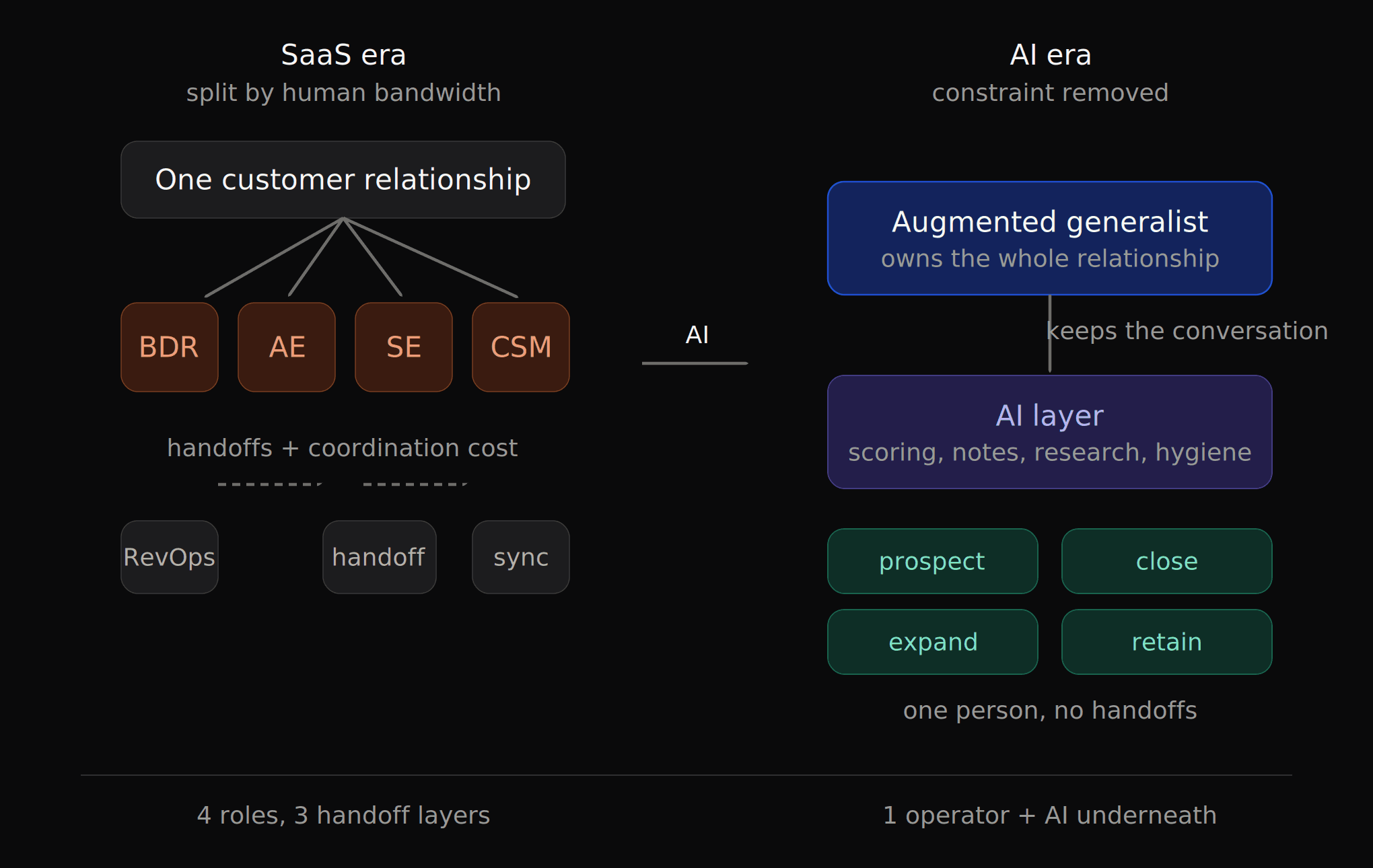
If you've built a go-to-market team in the last decade, you did it by adding specialists. An SDR to book meetings. An AE to run them. A sales engineer for technical depth. A CSM to retain and expand. A RevOps hire to keep the whole machine in sync. Each new stage of growth meant another narrow role and another handoff.
That instinct is about to cost you.
The constraint that justified all that specialization, the simple fact that no single person could be deep enough across the entire customer journey, is disappearing. AI now does the work that used to require separate humans. And the most advanced GTM teams in the world are quietly reorganizing around a different unit: not the specialized team, but the augmented generalist.
This article breaks down what's actually happening to GTM roles, why the specialist-heavy org chart was always a workaround rather than good design, and what it means concretely for how you hire, structure, and equip a revenue team in an AI-native world.
Why GTM teams fragmented in the first place
The specialized sales org didn't emerge because someone proved it was optimal. It emerged because of a bandwidth limit.
A single person cannot simultaneously be a great prospector, a sharp closer, a credible technical resource, and a strategic account manager. Those are different skills, different rhythms, and different time horizons. So companies broke the customer relationship into pieces small enough for one human to own well, then hired a person per piece and added management and tooling to coordinate between them.
This is the part most people miss: the org chart was the compromise, not the goal. Every handoff between an SDR and an AE, every sync between a sales team and a CS team, every RevOps process built to reconcile two systems of record, exists to manage the friction created by splitting one job across many people. A large share of modern revenue operations is, in effect, overhead generated by specialization itself.
That overhead made sense when specialization was the only way to get depth. It stops making sense the moment one person can be deep everywhere.
What AI actually changes about GTM roles
The popular framing is "AI will replace GTM jobs." That's the wrong model, and it leads to bad decisions.
What AI removes is not the human. It's the fragmentation. The tasks that get automated are precisely the ones that only existed because roles were split too thin: manual account research, data entry, CRM hygiene, turning call recordings into structured notes, scoring large lists, chasing status updates between teams. None of that is the actual value of a GTM professional. It's the connective busywork that filled the gaps between specialists.
Strip that away and something interesting happens. A single operator, with AI handling the volume underneath, can now credibly own the entire relationship: find the account, run the conversation, handle the technical depth, close, and keep the account growing. Not by working four times as hard, but because the parts that used to require three other people are now handled by a system.
The human keeps the one thing that has to stay human: the conversation. The judgment, the relationship, the read on what a customer actually needs. Everything mechanical underneath it gets delegated to the machine.
This is why the best operators are describing the same shift from different angles. In Attio's GTM Atlas, Travis Bryant of Anthropic puts it bluntly: the generalist is back. One person now plays what used to be three or four roles, deep in all of them, because AI does the heavy lifting. A customer success leader at Notion describes the collapse of the old retention-versus-expansion divide into a single continuous role. Linear's COO describes work that once took a data team, a growth team, and a sales team now being handled by one person with the right tools, which is why she hires for how fast someone learns rather than where they've worked.
Different surfaces, same underlying movement: the role boundaries that defined the SaaS-era org chart are dissolving because the constraint that created them is gone.
The generalist vs specialist question, settled by economics
Whenever this comes up, someone objects: surely specialists are still better at their specialty. True, in isolation. A dedicated SDR will out-prospect a generalist on raw activity. A dedicated CSM will know the renewal playbook more deeply.
But that comparison misses where the cost actually lives. The specialized model doesn't just pay for the specialists. It pays for everything required to connect them: the handoffs that leak context, the meetings to re-align, the management layer, the tooling tax of integrating systems that each team owns separately, and the deals that stall or churn in the seams between roles. Those coordination costs are invisible on an org chart and enormous in practice.
When one augmented operator owns the whole motion, those costs go to zero. No handoff between prospecting and closing if it's the same person. No reconciliation between the retention view and the expansion view if one person holds both. The org gets flatter not because flat is fashionable, but because the work no longer needs to be divided to be done well.
For a smaller company, the math is even starker. You were never going to hire the full specialist stack anyway. The choice was never "four specialists or one generalist." It was "an incomplete, overstretched specialist team, or one capable generalist properly equipped." AI makes the second option dramatically more viable.
What this looks like in practice: fewer tools, fewer roles, more leverage
The technology mirror of this shift is just as important as the org one, and it's where most teams get stuck.
The specialized org chart came with a specialized software stack to match: one tool for sequencing, another for enrichment, a CRM, a lifecycle platform, an analytics layer, and an integration tax connecting all of them. That stack made sense when each tool was operated by a different team. It makes far less sense when one operator owns the entire motion.
We've seen this directly. In a previous role, one of us led a migration off Salesforce onto Attio that cut licensing from roughly a million dollars a year to around thirty thousand, while making the system dramatically easier for a small team to actually run. The savings weren't really about the price tag. They came from collapsing a sprawling, specialist-operated setup into a composable stack that one team could own end to end.
That's the pattern we now build around at Novlini: a clean, composable GTM stack with a flexible data model at the center, where enrichment (Clay), outbound, and lifecycle messaging (Customer.io) clip into a single source of truth, and an AI layer can reason across the whole thing. We chose those tools by conviction first; the partnerships came later. The point isn't the specific logos. It's the architecture: an augmented generalist needs a connected stack they can operate alone, not a dozen disconnected point solutions each built for a separate specialist team.
How to tell if your GTM org is over-fragmented
If you're wondering whether this applies to you, here are the signals we look for when we assess a revenue org. Any one of them is a sign you may be paying a coordination tax that no longer needs to exist:
You have more people managing the process than running conversations with customers. When the ratio of coordinators, ops, and managers to actual customer-facing operators creeps up, you're funding fragmentation.
Leads die in the handoffs. If deals consistently stall or go cold in the transition between SDR and AE, or between sales and CS, the seams between roles are leaking value.
Your team spends more time updating systems than thinking. If your people are doing the research, the note-taking, and the data entry by hand, you're using expensive humans for work AI now does better and faster.
Nobody owns the full relationship. When a customer has to be re-explained internally at every stage because four different people each own a slice, the relationship itself has no owner.
You're about to hire a fifth specialist to fix a coordination problem. The instinct to add another narrow role is often a symptom, not a solution. Sometimes the answer is consolidation, not another hire.
If several of these are true, the highest-leverage move probably isn't another specialist. It's reorganizing around fewer, more capable operators, with AI and a connected stack doing the work that used to justify the extra headcount.
What I'd do if I were building a GTM team today
Start with the relationship, not the org chart. Design the team around how few people can own a complete customer journey, then equip them properly, rather than defaulting to a role per stage.
Hire for slope, not pedigree. In a world where the tools collapse the work, the scarce resource isn't ten years in one narrow lane. It's how quickly someone can operate across lanes and absorb new tooling. Curiosity and learning speed beat a polished but narrow résumé.
Invest in the stack before the headcount. A connected, composable stack with AI underneath often replaces the need for the next two or three hires. The leverage is in the system, not just the people.
Automate the connective tissue, protect the conversation. Push research, data entry, scoring, and note-taking to AI aggressively. Keep humans on judgment, relationships, and decisions. The failure mode is automating the conversation and keeping humans on the busywork, which is exactly backwards.
The takeaway
The specialist-heavy GTM org was a brilliant solution to a real constraint: human bandwidth. That constraint is lifting. As it does, the logic that justified splitting one relationship across four roles is unwinding, and the generalist who got broken into specialists is being put back together, with a machine doing the parts that never needed a human.
This isn't a threat to good GTM people. It's the opposite. It concentrates the work back into roles that are more senior, more complete, and more interesting, and it lets smaller teams compete with larger ones on leverage rather than headcount.
The companies that internalize this now will move faster with fewer people and less coordination drag than the ones still managing handoffs between roles that no longer need to be separate.
Novlini is an Elite Attio Expert Partner and a GTM engineering consultancy. We help B2B scale-ups and investment firms design and run composable GTM stacks built around one principle: fewer, more capable operators, with AI and a connected system doing the heavy lifting. If you're rethinking how your revenue team is structured or tooled, let's talk.