
About Ykone
Ykone is a global influencer marketing group founded in 2008, working with iconic brands in luxury, fashion, beauty, and travel. The group operates across multiple international offices and multiple business entities - Ykone, Bold, and Campaygn - each selling distinct services to overlapping clients. With a team of around 250 people across markets in Europe, Asia, and the Americas, Ykone manages complex, multi-country brand relationships where the same client might be targeted by different offices for different services simultaneously. Their Salesforce to Attio migration came with an additional complexity most CRM migrations don't have: a multi-entity, multi-geography commercial operation that needed a single source of truth.
The Challenge
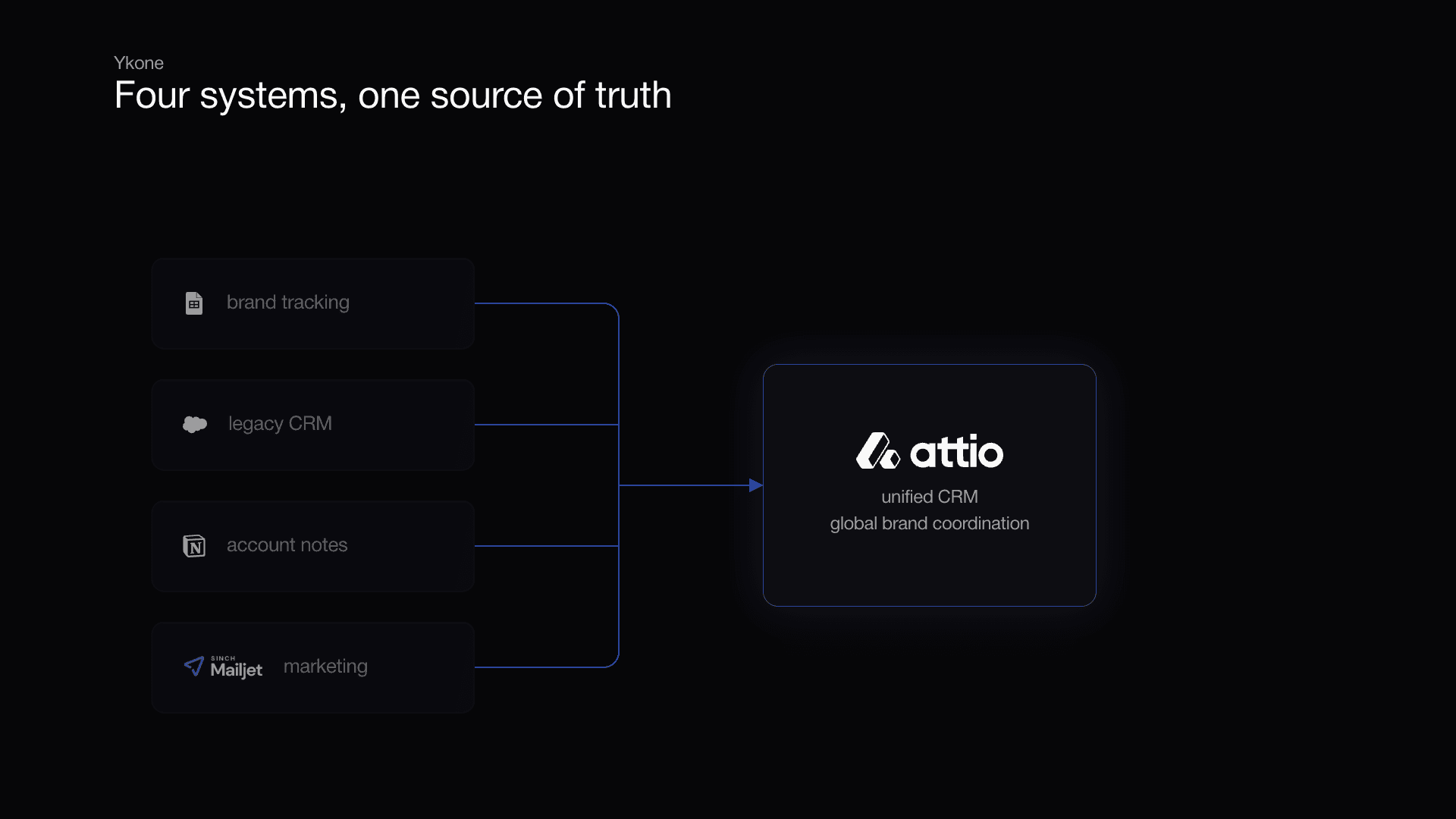
Ykone's sales and marketing activity was fragmented across four separate systems: Google Sheets, Salesforce, Notion, and Mailjet. None of them talked to each other. The result was a fundamental visibility problem: no one could see, from a single place, which offices were engaging with a given brand, what stage those conversations were at, and what cross-sell or expansion opportunities existed across countries and business lines.
Three specific problems drove the engagement:
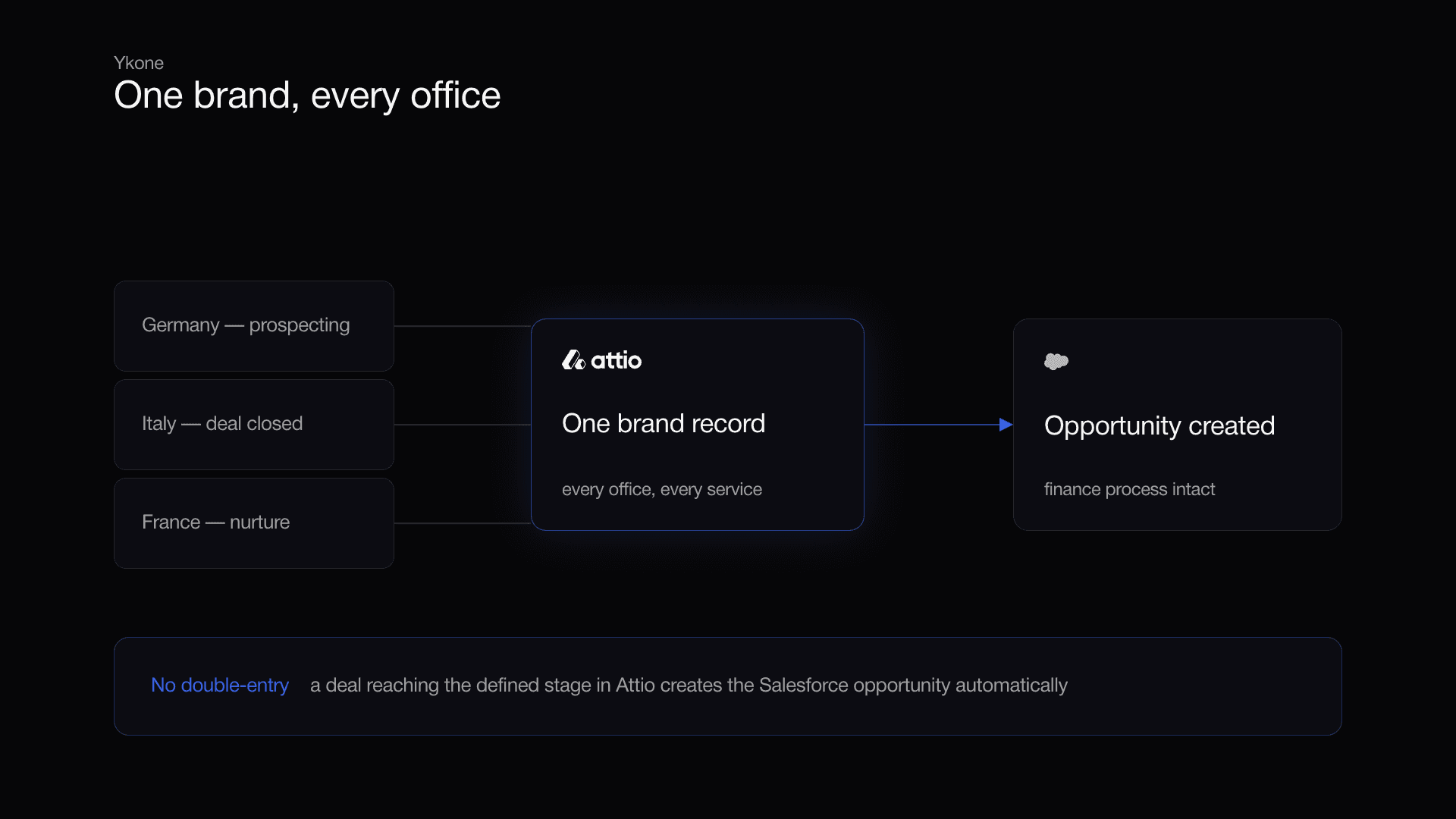
No global brand coordination layer. Ykone's most valuable accounts - luxury groups like LVMH, Kering, and others - are targeted by multiple offices for multiple services. Without a shared system, a sales lead in Germany had no way of knowing that Italy had just closed a deal with the same brand. Cross-sell and upsell opportunities were invisible.
No unified contact and activity history. Before a brand enters the sales pipeline, it receives newsletters, event invitations, and marketing touchpoints managed through Mailjet. None of this activity was connected to the CRM. The sales team had no view of how nurtured a prospect was before picking up the phone.
Manual reporting at scale. Pipeline reporting - by country, by service, by business line, by brand group - was done manually through spreadsheets. For a group operating across multiple offices and entities, this was unsustainable.
Our Approach
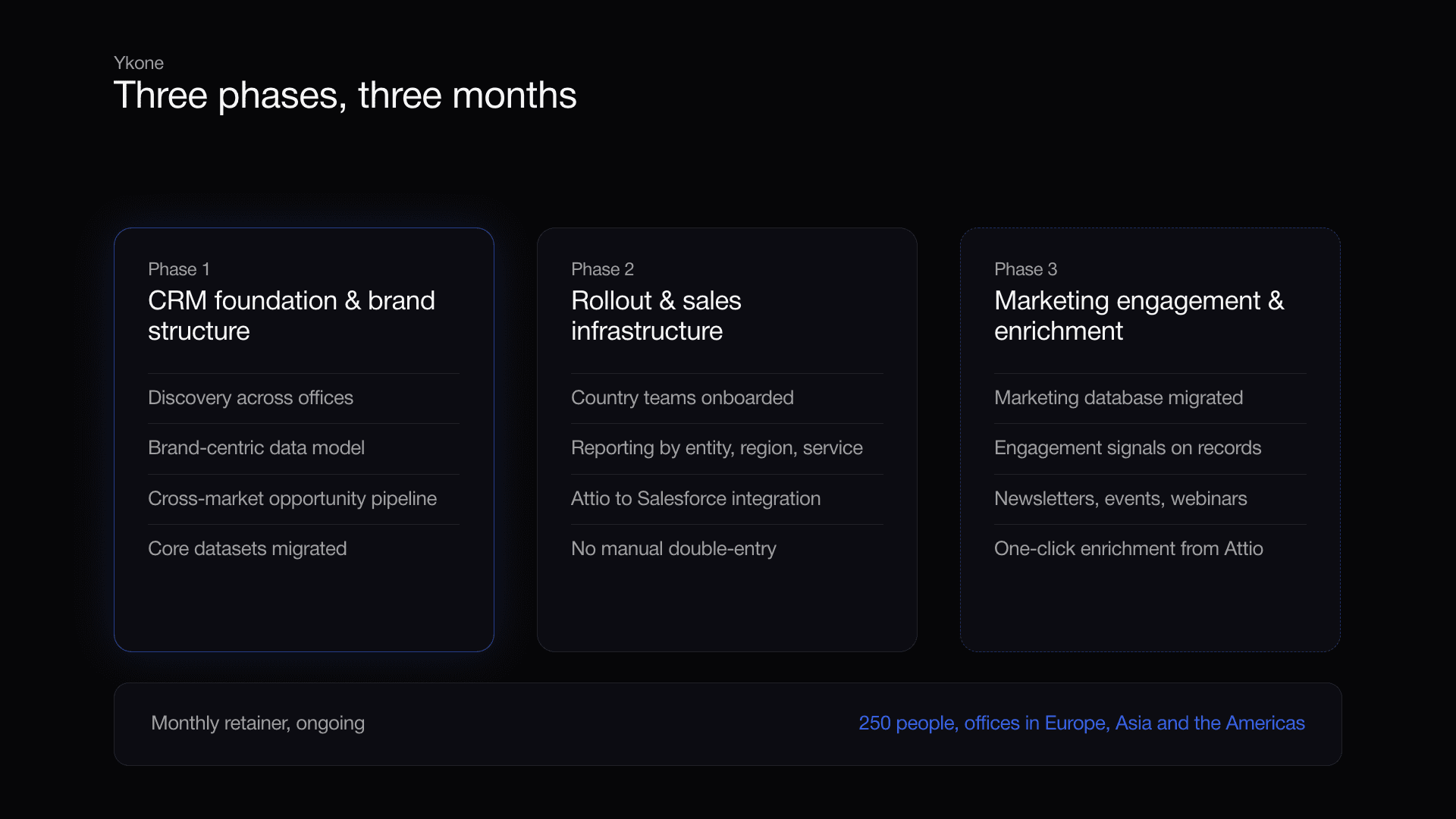
Novlini is engaged on a monthly retainer structured around three phases, delivering the full implementation over three months.
Phase 1 - CRM Foundation and Global Brand Structure
Discovery sessions with stakeholders across offices to map the existing workflows, brand tracking logic, and data sources. Based on this, Novlini designed an Attio data model purpose-built for Ykone's agency structure.
The key architectural decision: Brands as the central object, not Companies in the standard CRM sense. Each brand record tracks the full engagement history across all offices and services, with entity attribution (Ykone vs Bold vs Campaygn), market segmentation, contact hierarchy, and opportunity pipeline - all visible in a single record. Parent-child relationships between brand groups and local subsidiaries modeled to reflect how luxury conglomerates actually work.
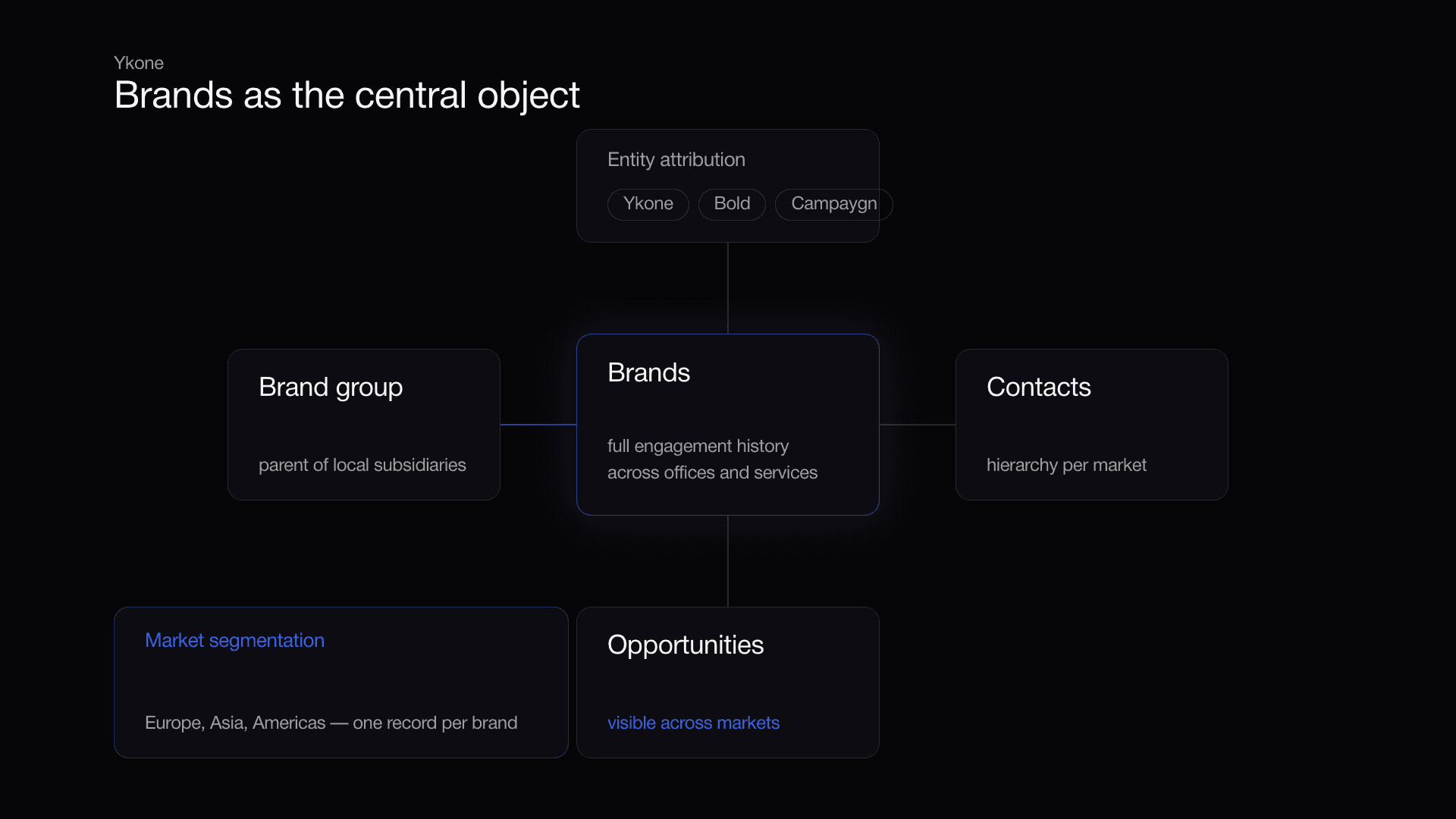
Opportunity pipeline configured with cross-market visibility: a sales lead in one country can see active deals and past interactions with the same brand from other offices before reaching out. Migration of core datasets from Google Sheets, Salesforce, and Notion carried out, with the team operational on Attio from day one.
Phase 2 - Operational Rollout and Sales Infrastructure
Onboarding of country teams across offices. Pipeline reporting and visibility across entities, regions, and service lines. Attio to Salesforce integration built: when a deal reaches a defined stage in Attio, a corresponding opportunity is automatically created in Salesforce - keeping the finance and post-sale process intact without requiring the sales team to do manual double-entry.
Phase 3 - Marketing Engagement and Enrichment Layer
Migration of the full marketing contact database into Attio. Integration of marketing outreach tooling to surface engagement signals (newsletters opened, events attended, webinar participation) directly on brand and contact records. Enrichment workflow from Attio using FullEnrich or equivalent, giving sales reps one-click access to enriched profiles without leaving the CRM.
Technology Stack
Attio - unified CRM, global brand coordination, multi-entity pipeline (source of truth)
Salesforce - post-sale finance process (bi-directional sync via Attio integration)
Mailjet - marketing outreach (engagement signals surfaced in Attio - Phase 3)
FullEnrich / Apollo - contact enrichment, integrated from Attio
The Results
Ykone went from four disconnected systems and zero cross-market visibility to a workspace where every office can see what every other office is doing with the same brand.
Cross-market coordination now possible - a sales rep in Germany can see active deals and past interactions with a brand from Italy or France before picking up the phone
Double-entry eliminated - deals created in Attio automatically trigger opportunity creation in Salesforce, no manual re-entry
Multi-entity pipeline live - Ykone, Bold, and Campaygn deals tracked and attributed in a single workspace with no ambiguity
Marketing and sales touchpoints on a path to unification - Mailjet engagement signals being connected to Attio records so the team can see the full nurture history before reaching out
Spreadsheet and Salesforce dependency broken - the commercial team no longer operates from a patchwork of tools with no shared view
"It is a pleasure working with Novlini. They have deep knowledge of the Attio platform, are not afraid of challenging tasks, and deliver what they promise. Highly recommended."
Stephane Allard - Chief AI Officer, Ykone ★★★★★
Why It Matters
Influencer marketing agencies face a CRM problem that standard tools are not designed to solve. The client is not a company - it is a brand, with regional subsidiaries, multiple decision-makers, and engagement happening simultaneously across offices and services. A Salesforce data model built around standard CRM objects breaks immediately when you try to track cross-market, multi-entity relationships at scale.
For any global agency or multi-entity commercial team managing accounts across countries and business lines, the Attio architecture that works starts with the brand - not the company - as the organizing principle. This is also one of the strongest arguments for Salesforce to Attio migration in the agency world: Attio's flexibility allows you to build the data model that reflects your business, rather than forcing your business into a predefined schema.