
How Novlini Uses Lemlist to Build Outbound Engines That Actually Work
Most sales teams buy Lemlist, connect it to a CSV export, and wonder why replies are flat. The tool is not the problem. The architecture is.
At Novlini, Lemlist is never a standalone purchase. It enters the stack as the execution layer of a broader outbound system, sitting downstream of Attio and Clay, with N8N holding the connective tissue together. The result is a different class of setup: one where every contact enrolled in a sequence has been scored, enriched, and validated first, where the CRM controls campaign activation instead of the other way around, and where every open, reply, and bounce lands back in Attio in real time.
This article breaks down how we build that system, what it looks like in practice, and why the sequencing decisions matter more than the platform itself.
Why Lemlist, Not Something Else
Before the architecture, the honest case for the tool.
Lemlist sits at a useful intersection: it handles email and LinkedIn in a single sequence, has deliverability infrastructure built in (Lemwarm), supports conditional branching based on engagement, and offers enough personalization flexibility to run quality-over-volume plays. It automates email follow-ups, LinkedIn actions, and calls from a single sequence, tracking lead interactions across channels in one unified inbox.
For the segment of clients we work with, that combination matters. Post-raise B2B startups and investment firms running founder-led outreach do not need 10,000 contacts per day. They need 50 well-targeted sequences that land well. Lemlist's architecture, particularly its multichannel sequencing and content spinning features, fits that brief.
A typical multichannel sequence moves from a personalized email on day zero, to a LinkedIn connection request, a follow-up email, a LinkedIn message, and a call step over roughly 11 days. Teams running this approach have observed reply rates increase by over 40% compared to email-only outreach.
The deliverability piece is not trivial either. Accounts where Lemwarm runs continuously maintain inbox placement in the 91-93% range, while pausing warmup during high-volume sending can drop placement to 85-87%. We enforce this on every engagement before a single email goes out.
The Architecture: Attio as the Command Center
The core design principle we apply across every client outbound build is this: Attio controls Lemlist, not the other way around.
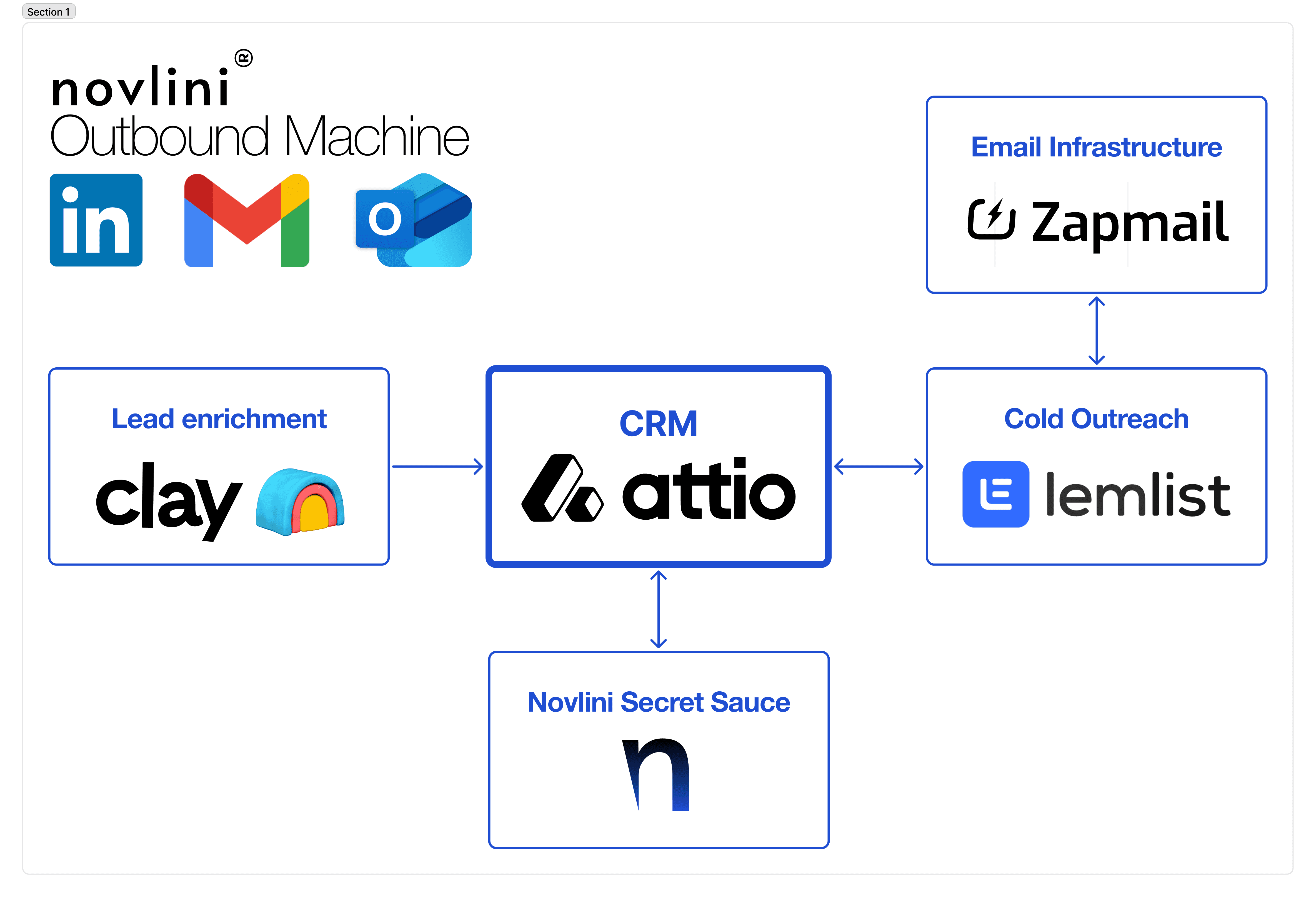
Most teams using Lemlist independently face the same problem. A rep replies to an email, but the contact is still active in a sequence. A prospect books a meeting, but is still receiving follow-ups three days later. Or worse: a contact responds, but the CRM does not know for 15 minutes, and an awkward third email goes out in the gap.
The fix is a direct API integration, not a Zapier relay. We build a bidirectional bridge between Attio and Lemlist through N8N, so that:
Contact enrollment into Lemlist sequences is triggered by a field change in Attio, not by manual CSV export
Every Lemlist event (email sent, opened, clicked, replied, bounced, LinkedIn invite accepted) syncs back to Attio as a structured activity record in real time
Campaign status fields in Attio reflect live Lemlist state, not yesterday's sync
The Campaign Dropdown Pattern
The specific UI pattern we use most often is what we call the Campaign Dropdown. On every People record in Attio, there is a single-select field called "Campaign." When a rep selects a value, an N8N workflow fires: it pushes the contact to the corresponding Lemlist sequence, sets the Email Status and LinkedIn Status fields to "Active," and logs the enrollment timestamp.
This design achieves a few things simultaneously. It forces manual review before any contact is enrolled. It prevents the same contact from being enrolled twice, because the field state reflects current campaign membership. And it gives sales managers a clean view of outbound activity from inside the CRM, without ever opening Lemlist.
We deployed this exact architecture for a B2B AI governance software company. Their outbound was previously manual, event-driven, and entirely disconnected from their CRM. After building the stack (Clay for TAM sourcing and scoring, N8N for orchestration, Lemlist for sequencing), they moved from zero to a live outbound system in six days, with 10 sending email addresses and two LinkedIn accounts running coordinated multichannel sequences.
The Full Stack in Practice
Layer 1: TAM Mapping and Enrichment in Clay
Lemlist sequences are only as good as the contacts entering them. Which is why we spend a significant portion of every engagement upstream, in Clay, before Lemlist is even configured.
The typical Clay workflow: define ICP criteria, source accounts from multiple data providers, run enrichment for firmographics and contact data, apply a scoring model that combines account-level fit (industry tier, company size, tech stack) with contact-level fit (seniority, role classification) and intent signals (hiring patterns, LinkedIn engagement, tooling adoption). Contacts scoring above a threshold are pushed to Attio's Outbound People list as MQLs. Those scoring below sit in Attio as Leads, visible but not yet activated.
For one healthcare-adjacent tech client, this process produced a scored and enriched pool of over 80,000 potential leads from two sources. Each contact arriving in Lemlist had already been validated at both the company and person level, with enriched icebreaker variables ready to populate sequence copy.
Layer 2: Sequence Architecture in Lemlist
A few decisions we enforce on every Lemlist build:
Multichannel cadence by default. Email only is acceptable for brand outreach. For B2B prospect sequences targeting decision-makers, we always include LinkedIn steps. For the clients where it fits (typically agencies and commercial teams), LinkedIn-first is often better: profile visit and connection request before the first email reduces cold-email friction significantly.
Content spinning from day one. Identical emails at scale trigger filters. We configure subject line variants, first-line variants, and CTA variants in every campaign before launch. Not doing this is one of the fastest ways to damage deliverability on a high-volume send.
Deliverability thresholds as hard stops. We set these before launch and document them: inbox placement above 80%, spam rate below 10%, bounce rate below 3%, hard bounce below 1%. If any threshold is breached, campaigns pause automatically and the team is alerted. For clients using Zapmail for warm-up infrastructure alongside Lemlist, we configure ESP matching to separate Google and Microsoft sending where needed.
Variable fields for personalization, not generic copy. On the Clarifeye engagement, we passed AI-generated icebreaker variables (VAR 1) and Loom video links (VAR 2) from Attio list entries directly into Lemlist sequences. The data entered Attio through Clay enrichment, flowed through N8N, and surfaced in Lemlist as dynamic fields at the contact level.
Layer 3: Sync Back to Attio
The return flow is where most integrations break down. Standard automation tools sync on a 15-minute or hourly delay. We build direct webhooks.
Lemlist fires events to N8N: email sent, opened, clicked, replied, bounced, opted out, LinkedIn invite sent, invite accepted, message sent, message replied. N8N writes each event to Attio as a timestamped activity on the Person record, updates the Email Status and LinkedIn Status fields on the Outbound People list entry, and triggers downstream logic where relevant. A reply, for example, triggers a task creation in Attio for the account owner, updates the Contact Stage, and pauses the contact in the active sequence.
For the Blue Foxes engagement, all outbound activity synced back into Attio daily across email and LinkedIn touchpoints. The commercial team could see exactly where each prospect was in the sequence without opening Lemlist, manage replies from inside the CRM, and review campaign performance on Attio dashboards we configured alongside the outbound stack.
Segmentation Logic Before Enrollment
One pattern that separates functional outbound from spray-and-pray: segmenting before push, not after.
In every setup we build, contacts are segmented in Attio before any campaign activation. The segmentation criteria typically combine score tier (high/medium, mapped to different sequences with different messaging angles), sourcing type (Clay-sourced TAM versus manually imported, versus event-sourced), intent signals at the person or account level, and lifecycle stage (Lead vs MQL vs SAL).
Different segments get different sequences. A Clay-scored MQL with high intent signals and a strong ICP fit gets a tighter, more direct sequence with fewer steps. A lower-scoring contact from a manual import might enter a lighter nurture track with a longer gap between touches. This logic lives in Attio, expressed through filtered views and list attributes, not inside Lemlist.
What We Monitor After Launch
Four levers control deliverability, and we track them consistently across every active campaign:
Inbox placement. We run placement tests inside Lemlist (campaign > email step > preview > "Test - Inbox placement") before launch, after major copy changes, and when reply rates drop unexpectedly. Target: inbox rate above 80%, spam rate below 10%.
Spam word risk. Plain text, neutral tone, one link maximum, no attachments in cold sequences. SpamAssassin score monitored on every sequence revision.
Content pattern diversity. We use Lemlist's content spinning for subject lines, first lines, and CTAs. Running 500 emails with identical structure is a deliverability risk regardless of send volume.
Bounce rate. Total bounce below 3%, hard bounce below 1%. Above 3% total means pause and re-validate the list before resuming. High bounce rate is the fastest path to domain damage.
For LinkedIn activity, benchmarks we work toward: invite acceptance rate in the 30-40% range, response rate above 30% of acceptances (so roughly 10% of all prospects contacted), and majority of responses opening a relevant conversation rather than asking to be removed.
Client Patterns Where This Architecture Works
The setups above are not theoretical. A few examples from recent engagements, described without client-identifying detail:
Early-stage B2B SaaS, expanding sales team. Outbound was previously manual and founder-led. Challenge was building a process before new reps onboarded. We built the full Clay-Attio-Lemlist stack, scraping the entire addressable market, scoring 80,000+ leads, and connecting Lemlist bidirectionally to Attio. First sequences launched before the new hires started.
Global media and content group, B2B commercial team. Two distinct ICPs required two distinct sequences with different channel weighting (LinkedIn-first for agencies, email-first for brands). Clay sourced and scored 3,500 qualified accounts from multiple sources, boosting data coverage from 60% to 90%. Lemlist configured with full bidirectional Attio sync via N8N. Campaigns live within three weeks of project start.
AI governance software, regulated enterprise market. Zero outbound infrastructure at engagement start. Six-day scope covering Attio restructuring, ICP definition, Clay workflow engineering, and Lemlist deployment. Multichannel sequences with 10 sending addresses and LinkedIn automation. Contact enrollment controlled entirely from an Attio dropdown, with Lemlist status syncing back in real time.
VC-backed fintech, migration from a legacy CRM. Pre-existing Lemlist usage but no CRM integration. Campaigns were running in isolation; replies were managed outside the CRM. We built the Attio-Lemlist bridge to consolidate all outbound activity into a single source of truth, added Clay enrichment to existing contact lists, and restructured sequences to include LinkedIn steps.
The Honest Limitations
Lemlist is not a data tool. It does not replace Clay or Apollo for list building, and its native enrichment is thin compared to dedicated providers. Teams expecting to run high-quality sequences from Lemlist's built-in database will be disappointed. The tool performs when fed with clean, enriched, scored data from upstream.
The multichannel features also require the right plan. LinkedIn automation and cold calling steps are gated behind the Multichannel Expert tier. At $79 per user per month billed annually, this is a meaningful commitment for small teams, but it is the tier required for the architecture we describe here.
And Lemlist is not a CRM substitute. The integration work we do, specifically the bidirectional Attio sync, is what makes it useful at the organizational level. Without that bridge, it is a capable sequencing tool being operated in a silo.
How to Engage Novlini on This
If your team is looking to build or improve an outbound engine using Lemlist as part of a composable stack, the starting point is always the same: an audit of what exists in Attio, a clear ICP definition, and a decision on Clay as the data layer before any sequencing tool is touched.
We scope outbound builds as Phase 1 engagements, typically 5-6 days covering discovery and Attio optimization, ICP and messaging design, and infrastructure deployment with campaign launch. The result is a live system your team can operate and iterate on independently.
Full case studies and the integration overview are available on novlini.io.