AI in CRM: How Artificial Intelligence Is Redefining Modern Go-To-Market Teams
From manual data entry to conversational CRMs. A practical vision of AI-powered CRM platforms, with Attio as the new standard and real-world implementations by novlini.
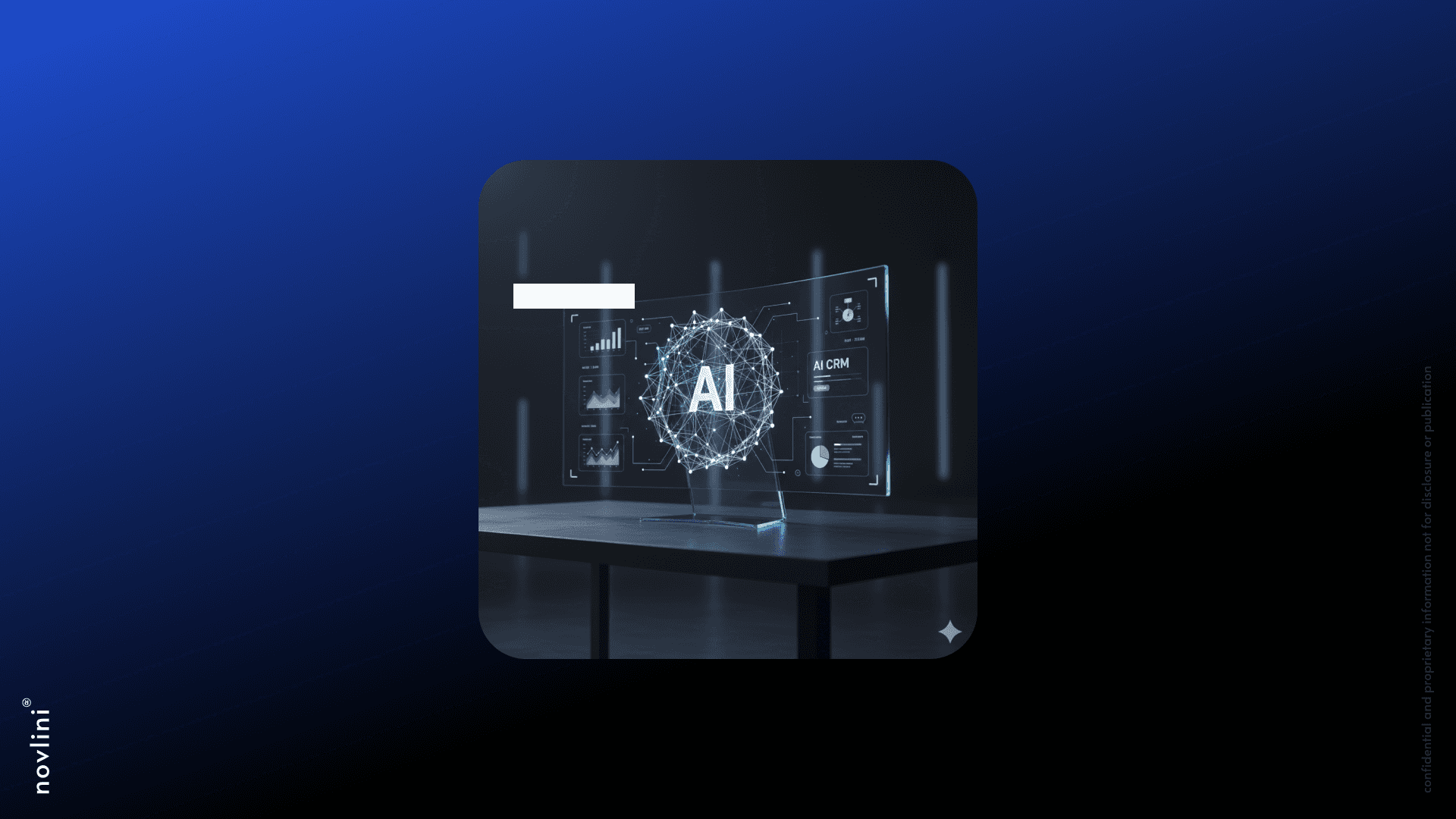
The Rise of AI in CRM: From Data Entry to Intelligent Sales Co-Pilot
Customer Relationship Management (CRM) platforms are undergoing a seismic shift. Once known for tedious data entry and siloed databases, modern CRMs are evolving into intelligent, AI-augmented co-pilots for sales and RevOps teams. Artificial intelligence in CRM is no longer a buzzword – it’s becoming the backbone of how startups and enterprises alike capture leads, manage pipelines, and drive revenue.
In this article, we explore how AI is transforming CRM platforms, compare the major players’ AI features, and highlight why novlini® believes the future of CRM is AI-native. We’ll also dive into Attio, a next-generation AI-powered CRM, and share real examples of how AI is revolutionizing workflows for go-to-market (GTM) teams. Finally, we discuss how novlini implements these AI capabilities in client CRM stacks, paving the way from manual data entry to conversational interfaces.
Why AI Is Transforming the CRM Landscape
CRM systems have always been the operating system of go-to-market teams. Yet for years, many teams viewed their CRM as a necessary evil – a clunky database out of sync with fast-paced sales motions. Reps hated updating it, data quickly became stale, and critical context was scattered across emails and call notes.
AI is changing that equation.
Instead of spending hours on administrative work, sales teams can now rely on AI assistants to log calls, summarize meetings, draft follow-ups, and maintain data hygiene automatically. Instead of manually reconstructing customer context, AI can instantly surface the full story of an account.
This marks a shift from CRM as a static system of record to CRM as a dynamic system of action.
Crucially, this transformation is no longer reserved for large enterprises. Thanks to modern large language models (LLMs) and embedded AI features, even startups can deploy sophisticated AI-augmented CRM workflows. GTM teams adopting AI report shorter sales cycles, better data quality, and more informed decision-making. Those who delay risk falling behind as AI-driven personalization and automation become table stakes.
AI Features in Today’s Top CRM Platforms
Most major CRM vendors have acknowledged the AI wave. Here’s how leading platforms are approaching AI today.
HubSpot
HubSpot has rolled out AI tools such as Content Assistant and ChatSpot. Content Assistant (powered by OpenAI) helps teams generate emails, landing pages, and blog content. ChatSpot introduces a conversational interface that lets users add contacts, build reports, and draft sales emails using natural language.
HubSpot also leverages AI for conversation intelligence, call transcription, and predictive lead scoring. These tools are designed to save time across marketing, sales, and service teams, though they still operate within a legacy CRM architecture.
Salesforce
Salesforce has expanded its long-standing Einstein AI into Einstein GPT, positioning it as a generative AI layer across its Customer 360 platform. Einstein GPT can generate sales emails, call summaries, knowledge articles, and even code.
Salesforce’s AI delivers predictive insights at massive scale, from lead scoring to opportunity risk detection, and allows users to trigger actions via natural language queries. However, AI remains an added layer on top of a highly complex legacy system, often requiring significant configuration and governance.
Pipedrive
Pipedrive focuses on AI assistance for SMB sales teams. Its AI Sales Assistant surfaces pipeline insights, identifies stalled deals, predicts win probabilities, and recommends next-best actions. Pipedrive also includes AI email drafting and summarization tools to help reps act faster with less manual effort.
Zoho CRM (Zia)
Zoho CRM offers one of the most comprehensive AI assistants on the market through Zia. Zia supports conversational queries, predictive analytics (lead conversion, churn risk), automated enrichment, sentiment analysis, and even on-the-fly CRM configuration.
Zoho’s AI breadth is impressive, particularly for organizations already embedded in the Zoho ecosystem, though its UX and extensibility can feel heavy for fast-moving GTM teams.
Close
Close embeds AI deeply into inside-sales workflows. Its AI Notetaker transcribes calls and generates summaries automatically. AI Drafts produce personalized follow-up emails, while AI Enrich pulls live data from LinkedIn and the web.
Close also supports advanced LLM integrations, enabling power users to query CRM data with tools like ChatGPT or Claude for deeper insights and automated actions.
The Limits of Retrofitted AI
While these platforms are racing to add AI features, most are still constrained by legacy architectures. AI often feels bolted on, with limited context awareness, delayed data synchronization, or fragmented user experiences.
This has opened the door to a new generation of AI-native CRMs designed from the ground up for intelligence, flexibility, and real-time context.
The clearest example today is Attio.
Attio: An AI-First CRM Built for the Next Decade
Unlike incumbents, Attio was designed with AI at its core. It is a programmable, modern CRM built to adapt to how GTM teams actually work.
Universal Context
At the heart of Attio is Universal Context, a unified intelligence layer that semantically indexes all CRM data – records, emails, call transcripts, notes, product usage, and integrations – into a single, consistent knowledge graph.
This allows Attio’s AI to understand not just isolated data points, but the relationships and narrative across the entire customer lifecycle, in real time.
Ask Attio: Conversational CRM
Built on Universal Context, Ask Attio introduces a conversational interface that lets teams search, update, and act inside the CRM using natural language.
Meeting prep, post-call updates, pipeline changes, follow-ups, and even cross-account analysis can all be handled through conversation. The CRM becomes an assistant rather than a system to manage.
Agent-Ready Architecture
Attio’s programmable data model and open APIs allow AI agents to safely read and write CRM data. This enables advanced automation, autonomous enrichment, proactive pipeline monitoring, and future-proof integrations with external AI systems.
This agent-first architecture is what allows Attio to move beyond “AI features” and toward AI-driven workflows.
How novlini Implements AI in Real CRM Stacks
At novlini®, we don’t treat AI as a buzzword. We implement it pragmatically to solve GTM problems.
Our approach includes:
Selecting the right CRM architecture (often Attio) based on scalability and AI readiness
Designing prompt-driven workflows for meeting prep, follow-ups, pipeline updates, and insights
Connecting AI services to CRM data via APIs and automation tools
Implementing human-in-the-loop safeguards for trust and quality
Training GTM teams to work with AI, not around it
We focus on outcomes: cleaner data, faster execution, better decisions.
From Manual Data Entry to Conversational CRM
The direction is clear. CRM is becoming conversational, autonomous, and intelligence-driven.
Teams will increasingly interact with CRM systems by asking questions, not clicking fields. AI will surface insights proactively, execute routine actions, and coach teams in real time.
The winners won’t be the teams with the most dashboards. They’ll be the ones with CRMs that think alongside them.
Final Thought
AI in CRM is no longer optional. It’s the foundation of modern GTM execution.
Platforms like Attio show what’s possible when CRM is built for the AI era. And with the right architecture and implementation partner, teams can move faster, smarter, and with far less friction.
The CRM of the future isn’t a database.
It’s a co-pilot.
And that future is already here.